
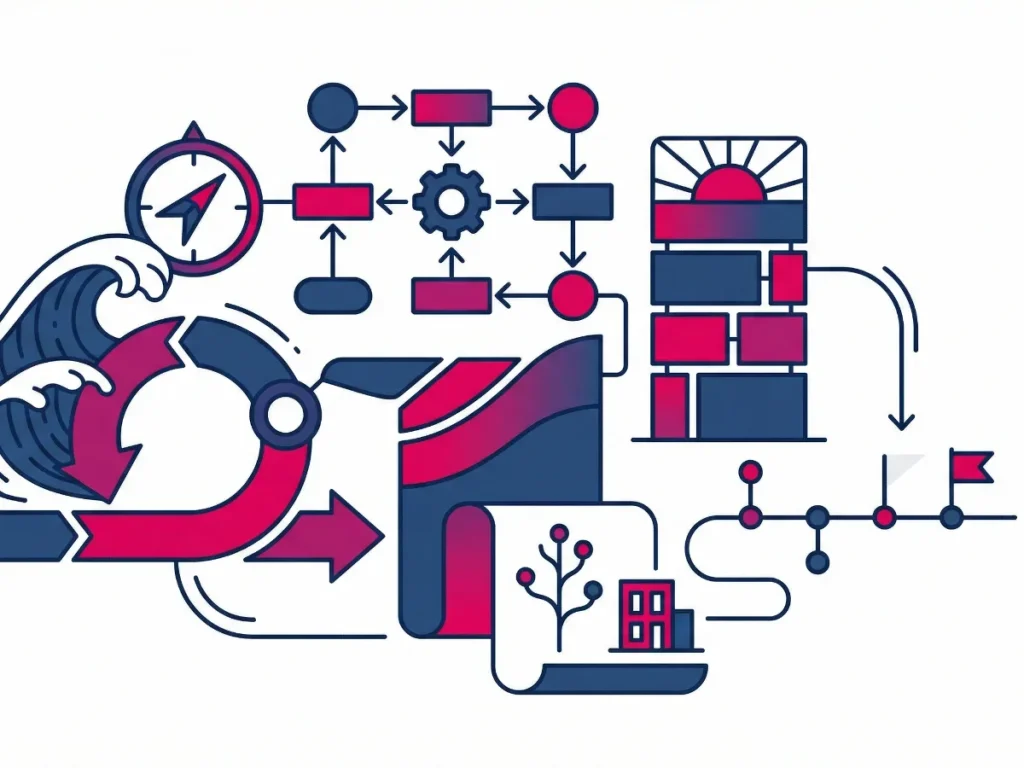
Traditional project management asks a team to plan everything up front, then execute against that plan for months at a time. Agile project management starts from a different assumption: requirements will change, priorities will shift, and the plan that made sense in week one may not make sense in week six. Instead of resisting that reality, Agile is built around it.
At its core, Agile breaks a large project into short, repeatable cycles — often called sprints — typically lasting one to four weeks. At the end of each cycle, the team delivers something usable, reviews it with stakeholders, and adjusts the next cycle based on what was learned. This rhythm of build, review, and adapt is what lets Agile teams respond to change without losing momentum.
The Core Principles Behind the Method
Agile is often reduced to a set of ceremonies — daily stand-ups, sprint planning, retrospectives — but the ceremonies are only useful if the underlying principles are understood. Four ideas matter most:
- Working output over exhaustive documentation. A demo that stakeholders can react to is worth more than a fifty-page specification nobody reads until it is already outdated.
- Collaboration over rigid contracts. Requirements are refined continuously through conversation with the people who will actually use the result.
- Responding to change over following a fixed plan. The plan is a starting point, not a contract that ignores new information.
- Individuals and interactions over process for its own sake. Frameworks exist to support the team, not the other way around.
These principles apply well beyond software, which is where Agile originated. Marketing teams, HR departments, and operations groups all deal with shifting priorities and incomplete information at the start of a project — which is exactly the environment Agile was designed for.
Where Teams Usually Get Stuck
Most teams that struggle with Agile are not failing because the framework is flawed — they are failing because they adopted the ceremonies without the mindset behind them. A daily stand-up that turns into a status report to a manager is not Agile; it has just changed the format of a task that Agile was meant to eliminate. Real adoption requires training that goes beyond terminology and gets into how a team actually makes decisions, handles conflict, and prioritizes work under pressure.
This is also where the choice of framework matters. Scrum, Kanban, and hybrid approaches all solve the same underlying problem in different ways, and picking the wrong one for your team’s context can undo a lot of the benefit. Our project management training programs walk through these trade-offs in depth, with practical exercises rather than theory alone.
Agile is not a set of meetings. It is a decision-making habit that treats every plan as the best current guess, not a fixed commitment.
Getting Your Team Started the Right Way
The fastest path to a functioning Agile team is structured, instructor-led training rather than trial and error. A good program covers the mechanics of the framework, but just as importantly, it builds the facilitation and stakeholder-management skills that keep an Agile team productive once the novelty wears off.
If you are evaluating where Agile training fits for your organization, our trainers bring two decades of hands-on delivery experience across industries, not just certification-exam preparation. You can see the breadth of what we cover on our training programs page, or reach out directly through our contact page to talk through what would work best for your team.
Leave a Reply